Zhuge Liang
諸葛亮
Courtesy name: Kongming (孔明)
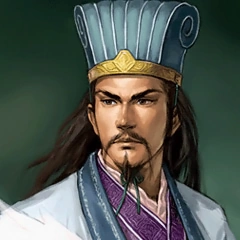
Source:
Koei Wiki (Fandom)
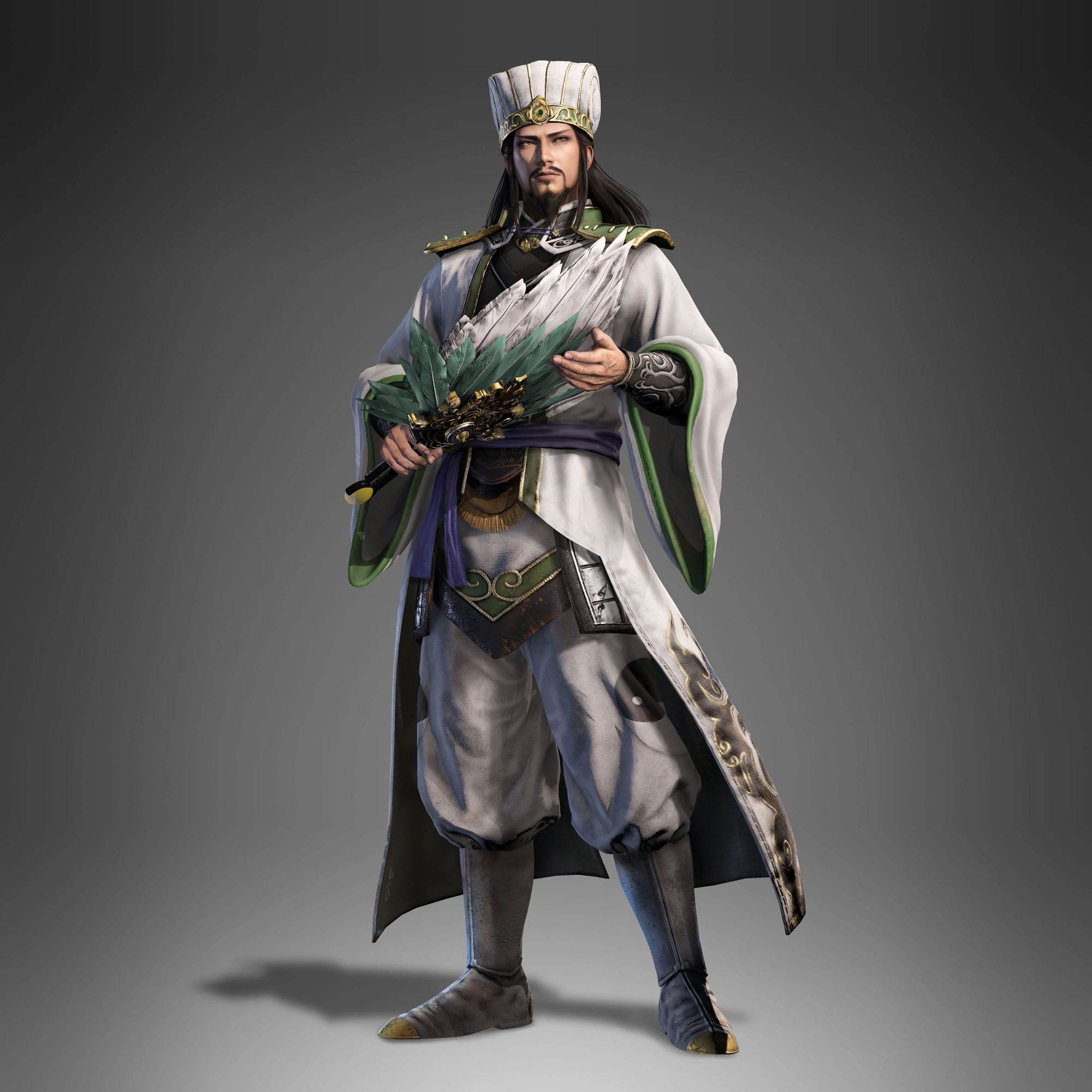
Source:
Koei Wiki (Fandom)
- Born
- 181
- Died
- 234
- Ancestral home
- Yangdu, Langya (Yinan County, Shandong)
- Book mentions
- 1454
Roles:
advisor
general
politician
regent
Factions:
Shu Han
(primary)
Relationships:
Zhuge Feng
Ancestor
Zhuge Jin
Brother
Zhuge Jun
Brother
Zhuge Dan
Cousin
Zhuge Gui
Father
Huang Chenyan
Father-in-law
Zhuge Jing
Grandson
Zhuge Shang
Grandson
Zhuge Ke
Nephew
Zhuge Qiao
Nephew
Zhuge Zhan
Son
Zhuge Xuan
Uncle
Lady Huang
Wife
Links:
-
Wikipedia entry Bio
Appears in 77 chapters:
-
Chapter 9
— Lu Bu Kills Dong Zhuo For Wang Yun; Li Jue Attacks The Capital On Jia Xu's Advice.
Zhuge Liang; not yet appeared in the action; named in passing in an authorial aside foreshadowing his future significance.
-
Chapter 36
— Shan Fu's Strategy: Fankou Is Captured; Xu Shu's Affection: Zhuge Liang Is Recommended.
Introduced by Xu Shu's parting speech - Master Sleeping Dragon of the ridge in Nanyang, superior to his own models Guan Zhong and Yue Yi, 'the talent to measure the heavens and mete the earth' - and then met in the flesh for one sharp moment: told Liu Bei is coming, he shakes out his sleeves at Xu Shu - 'so you have made me a victim of the world's sacrifice' - and walks out.
-
Chapter 37
— Sima Hui Recommends A Scholar To Liu Bei; Liu Bei Pays Three Visits To The Sleeping Dragon Ridge.
Zhuge Liang; not directly met yet. The chapter sketches him through his friends and family - Cui Zhouping, Shi Guangyuan, Meng Jian - and through his own brother and father-in-law. Each conversation deepens the portrait without revealing the man.
-
Chapter 38
— Zhuge Liang Plans For The Three Kingdoms; Sun Quan Attacks Xiakou To Take Revenges.
Zhuge Liang's introduction in person - the famous Third Visit. Found napping in his thatched cottage at the foot of the ridge. After Liu Bei waits respectfully for hours, Zhuge Liang wakes, exchanges the formal greetings, and lays out the Longzhong Plan: hold Jingzhou and Yizhou, ally with Sun Quan, restore the Han. Joins Liu Bei at twenty-seven.
-
Chapter 39
— At Jingzhou, The Son Of Liu Biao Thrice Begs Advice; At Bowang Slope, The Directing Instructor Plans His First Battle.
Zhuge Liang's first command - designs the Bowang Slope fire ambush against Xiahou Dun's 100,000-strong invasion. Guan Yu, Zhang Fei and Zhao Yun execute it; the Wei van is annihilated. Zhang Fei admits 'Zhuge Liang is really a fine strategist' - the chapter that wins his brothers' trust.
-
Chapter 40
— Lady Cai Renounces Jingzhou; Zhuge Liang Burns Xinye.
Zhuge Liang; designs the second Xinye fire ambush - burns Cao Cao's vanguard with floods of pitch and oil arrows. Coordinates the southward exodus with the brothers across multiple guards. The chapter's headlining stratagem.
-
Chapter 41
— Liu Bei Leads His People Over The River; Zhao Zilong Rescues The Child Lord At Dangyang.
Burns the boats behind the Fancheng crossing, points the march at defensible Jiangling, and - when no word comes back from Guan Yu - rides for Jiangxia himself with Liu Feng and five hundred troops. His own family he has already spirited to the Three Gorges, to Cao Cao's fruitless disgust.
-
Chapter 42
— Screaming Zhang Fei Triumphs At Long Slope Bridge; Defeated Liu Bei Marches To Hanjin.
His dispositions unfold like clockwork: Guan Yu pre-placed at Hanjin, Liu Qi's fleet sent to the crossing, his own boats mustered from Xiakou. When Lu Su's sail appears he laughs 'It is done!' - coaches Liu Bei into strategic ignorance, dangles the fictitious refuge with Wu Ju until Lu Su begs him to come south, and boards the little boat to 'set north and south at each other's throats.'
-
Chapter 43
— Zhuge Liang Disputes With The Southern Scholars; Lu Su Denounces The Majority Opinion.
Zhuge Liang at Chaisang debates Sun Quan's pacifist scholars one by one - Zhang Zhao, Yu Fan, Lu Ji, Bu Zhi, Xue Zong, Yan Jun, Cheng Bing - and demolishes their case for surrender. The chapter's set piece argument.
-
Chapter 44
— Zhuge Liang Stirs Zhou Yu To Actions; Sun Quan Decides To Attack Cao Cao.
Sits smiling through the Zhou Yu-Lu Su wrangle, agrees sweetly with 'surrender', then springs the trap: Cao Cao's whole expedition wants only two women - and he recites the Bronze Bird ode with 'he would have the two Qiaos, these beautiful ladies of Wu' planted in it. The feigned apology seals it. Next day he sends Zhou Yu back to dissolve Sun Quan's last doubt about the numbers - reading the lord's heart so exactly that Zhou Yu privately marks him for death.
-
Chapter 45
— At The Three Gorges, Cao Cao Loses Soldiers; In The Gathering Of Heroes, Jiang Gan Is Trapped.
Reads the Iron Pile Mountains errand as a death warrant and accepts it anyway, teases Zhou Yu into cancelling it with a street-rhyme about one-direction talents, peers into the banquet tent and relaxes at the sight of Guan Yu behind his lord's chair - and leaves Liu Bei with the chapter's quietest bombshell: on the twentieth of the eleventh month send Zhao Zilong to the south bank, 'when the southeast wind begins, I shall return.'
-
Chapter 46
— Using Strategy, Zhuge Liang Borrows Arrows; Joining A Ruse, Huang Gai Accepts Punishment.
Signs the three-day arrow warrant in front of the whole assembly, idles two days, then sails twenty straw-lined boats into the fifth-watch fog and lets Cao Cao's ten thousand archers fill both sides of every dummy - 'we thank you, Sir Prime Minister, for the arrows!' Back ashore he matches palms with Zhou Yu on the word 'Fire', reads the Cai brothers' false desertion at a glance, and knows the beating of Huang Gai for a ruse while pretending resentment like everyone else.
-
Chapter 48
— Banquet On The Great River, Cao Cao Sings A Song; Battle On Water, Northerners Fight With Chained Ships.
Zhuge Liang; off-stage in the chapter; called for at chapter's end by the prostrate Zhou Yu - only Zhuge Liang knows what's wrong.
-
Chapter 49
— On Seven-Star Altar, Zhuge Liang Sacrifices To The Winds; At Three Gorges, Zhou Yu Liberates The Fire.
Writes Zhou Yu's diagnosis in sixteen characters - 'all are in your wish, but wind from the east' - and prescribes himself: the nine-span Altar of the Seven Stars, three ascents a day, and at the third watch the southeast wind rises. He is already gone when the assassins reach the altar, Zhao Zilong's boat carrying him home to issue the night's dispositions: Zhao Zilong to the Black Forest, Zhang Fei to Hulu Valley, Liu Qi to Wuchang - and Guan Yu, bound by a written pledge, to the Huarong Road where the stars say Cao Cao must pass and must not die.
-
Chapter 50
— Zhuge Liang Foresees The Huarong Valley Episode; Guan Yu Lifts His Saber To Release Cao Cao.
Congratulates Guan Yu with a cup of wine for 'removing the empire's worst foe' - the gentlest possible spring of the trap - then hears the confession he predicted and orders the execution the written pledge demands, staging the mercy that will rebalance the brothers.
-
Chapter 51
— Cao Ren Withstands The South Land; Zhuge Liang Angers Zhou Yu.
Coaches Liu Bei's every word of the wager, then harvests Zhou Yu's victory whole: as the night raid breaks, Zhao Zilong takes emptied Nanjun; Chen Jiao's captured seal forges the orders that march the Jingzhou garrison and Xiahou Dun's Xiangyang force off to 'rescue' Cao Ren - and Zhang Fei and Guan Yu walk into both cities. Three cities without one southern casualty avenged.
-
Chapter 52
— Zhuge Liang Negotiates With Lu Su; Zhao Zilong Captures Guiyang.
Produces the living Liu Qi to silence Lu Su's demand and concedes only 'should he die'; on campaign he plays the bait himself - the four-wheeled carriage and feather fan drawing Xing Darong through the parted ranks to Zhang Fei - spares the captured champion to turn him, reads the counter-ruse, and takes Lingling with two ambushes. He then settles the Guiyang command by lot and endorses Zhao Zilong's three reasons for refusing the widow.
-
Chapter 53
— Guan Yu Releases Huang Zhong; Sun Quan Fights With Zhang Liao.
Briefs Guan Yu on the sixty-year-old 'warrior of a thousand' and is scorned for it; sends Liu Bei after him with supports, reads the black flag and the thrice-croaking crow as Changsha taken and a great leader mastered - and, when the falling star announces Liu Qi's death, has the answer ready for the claim that must follow: 'I will have somewhat to say to anyone who comes.'
-
Chapter 54
— The Dowager Marchioness Sees Her Son-In-Law; The Imperial Uncle Takes A Worthy Consort.
Demolishes the rendition claim - the empire is the Liu estate, and where was Zhou Yu without the southeast wind? - then concedes the paper that concedes nothing: temporary occupation until Yizhou falls, with Lu Su maneuvered into signing as guarantor. When the marriage bait arrives he smells Zhou Yu, consults the oracle behind the screen, and packs Zhao Zilong off with three silken bags: 'let Zhou Yu employ all his ruses - his calculations will always fail halfway.'
-
Chapter 55
— Liu Bei Rouses The Spirit Of Lady Sun; Zhuge Liang A Second Time Angers Zhou Yu.
The author off-stage until the last page: the three bags play out exactly as sealed, and he is waiting in the hold of the twentieth boat in Daoist dress - 'my lord, again you see Zhuge Liang; he has waited a long time.' He lands the party, springs Guan Yu, Huang Zhong, and Wei Yan on the pursuing marines, and sends the four foolish generals home with a message: tell Zhou Yu not to use the Fair Damsel Trick again.
-
Chapter 56
— Cao Cao Feasts In The Bronze Bird Tower; Zhuge Liang Provokes Zhou Yu A Third Time.
Directs Liu Bei's tears from behind the screen and answers Lu Su with the unanswerable: Liu Zhang is my lord's blood - attack him and bear the world's blame, yield Jingzhou first and have nowhere to rest. When the borrowed-road offer arrives he nods Liu Bei into accepting it, then names the ruse - 'Borrow a Road to Destroy the Host' - and sets the hidden hook: 'if Zhou Yu is not killed, he will be nine-tenths a corpse.'
-
Chapter 57
— Sleeping Dragon Mourns In Chaisang; Young Phoenix Intervenes At Leiyang.
His letter kills the western expedition and, the poem implies, its author; reading the falling star he smiles 'Zhou Yu is dead' - then sails to Chaisang under Zhao Zilong's guard and delivers the threnody that converts the hostile mourners: 'people lied when they said these two were enemies.' On the shore Pang Tong clutches his arm; he answers with a letter of introduction to Liu Bei - and later has to explain why the transcendent drink themselves through paltry posts.
-
Chapter 58
— Ma Chao Launches An Expedition For Revenge; Cao Cao Flees The Field In Disguise.
Answers the southern alarm with one sentence - 'I can prevent Cao Cao from even daring to look southeast' - and does it by post: the letter that points the grieving Ma Chao at Tong Pass. Three hundred thousand men turn around without a battle.
-
Chapter 60
— Zhang Song Turns The Table On Yang Xiu; Pang Tong Proposes The Occupation Of Shu.
Deflects Zhang Song's probing with the party line ('Jingzhou is only ours temporarily'), and when the march is settled insists the base 'must be very well defended' — staying behind to hold Jingzhou with Guan Yu, Zhang Fei, and Zhao Zilong.
-
Chapter 61
— In The River, Zhao Zilong Recovers Liu Shan; With One Letter, Sun Quan Repulses Cao Cao.
Holds Jingzhou; meets the returning rescuers with a squadron of ships and writes the whole river adventure to Liu Bei at Jiameng.
-
Chapter 62
— The Taking Of River Fu Pass, Yang Huai and Gao Pei Perish; The Siege Of Luocheng, Huang Zhong and Wei Yan Rival.
Zhuge Liang; at Jingzhou.
-
Chapter 63
— Zhuge Liang Mourns For Pang Tong; Zhang Fei Releases Yan Yan.
Zhuge Liang; leaves Jingzhou with Zhao Yun and Zhang Fei to reinforce Liu Bei; assigns Guan Yu to hold Jingzhou. The split that will eventually cost Shu the eastern half of its empire.
-
Chapter 64
— Zhuge Liang Plans For The Capture Of Zhang Ren; Yang Fu Borrows Soldiers To Destroy Ma Chao.
Baits the trap in person: a mob of deliberately disordered soldiers, himself fanning in a four-wheeled carriage — 'dare you withstand me when Cao Cao's million troops fled at my name?' — and Zhang Ren charges across the Golden Goose Bridge into the net of five armies. Then sends the pacification columns out and asks Fa Zheng for the letter to Chengdu.
-
Chapter 65
— Ma Chao Battles At Jiameng Pass; Liu Bei Takes Over Yizhou.
Goads Zhang Fei into a written pledge before Jiameng ('only Guan Yu could stand against Ma Chao'), arrives to stop the duel before it kills a general, and unpicks Ma Chao bloodlessly: Sun Qian's gold to the bribable Yang Song, the promise to memorialize Zhang Lu as Prince of Hanzhong, and Li Hui's tongue for the finish. Then the law debate — Qin's cruelty against Liu Zhang's laxity — and the letter that flatters Guan Yu into staying at Jingzhou.
-
Chapter 66
— Armed With Sword, Guan Yu Goes To A Feast Alone; For The State, Empress Fu Offers Her Life.
Counter-scripts his brother's mission before it starts: houses him in the guest-house, prostrates himself weeping before Liu Bei to extract the pre-agreed 'reluctant' offer of three territories — and is conveniently away on a journey when Zhuge Jin comes back to complain.
-
Chapter 67
— Cao Cao Conquers Hanzhong; Zhang Liao Terrorizes Xiaoyao.
Answers the Hanzhong panic with a diversion: give Sun Quan three territories and point him at Hefei — 'I can make Cao Cao retreat of his own accord.'
-
Chapter 70
— Zhang Fei Takes Wakou Pass With Tactics; Huang Zhong Captures Tiandang Mountain By Stratagem.
Reads Zhang Fei's fifty-day drinking bout as a deep plan and arms it with fifty vessels of Chengdu's best; then plays the age-goad on Huang Zhong — doubting him into fury, dangling Guan Yu's name — to send the veterans out white-hot, promising the sniggering hall that 'the attainment of Hanzhong depends upon these two.' Consents to Dingjun only with an overseer attached.
-
Chapter 71
— At Opposite Hill, Huang Zhong Scores A Success; On The River Han, Zhao Zilong Conquers A Host.
Arms the expedition before it marches: Fa Zheng attached to Huang Zhong, Zhao Yun trailing as the safety line, Liu Feng and Meng Da's banner-show in the hills — then, with Dingjun won, aims the next blow at Cao Cao's grain: 'burn what he has and he will have little spirit left to fight.'
-
Chapter 72
— Zhuge Liang's Wit Takes Hanzhong; Cao Cao's Army Retires To The Ye Valley.
Takes Hanzhong by nerves: three nights of bombs and phantom drums move Cao Cao ten miles without a battle; the river-at-back camp and the litter of abandoned weapons play his suspicion like an instrument — 'I have defeated him by playing upon his doubts.' Then the finishing design: supplies cut, hills fired, and every retreat road pre-ambushed.
-
Chapter 73
— Liu Bei Becomes The Prince Of Hanzhong; Guan Yu Marches To Attack Xiangyang.
Zhuge Liang; orchestrates the kingship petition; lays out the Five Tiger Generals - Guan Yu, Zhang Fei, Zhao Yun, Ma Chao, Huang Zhong. Then orders Guan Yu north to capture Fancheng - the war that will kill him.
-
Chapter 76
— Xu Huang Fights At The River Mian; Guan Yu Retreats To Maicheng.
Named in passing — Meng Da recalls how he declined to advise on the succession, deflecting the heir question back into the family.
-
Chapter 77
— Cao Cao Is Possessed At Luoyang; Guan Yu Manifests At The Jade Spring Mount.
Reads the falling star over Jingzhou and hides it to spare his master, soothes the night apparition as overthinking — and, caught out by the eavesdropping Prince, can only brand Liu Feng and Meng Da's refusal 'even too great for death' and offer to lead the rescue himself.
-
Chapter 78
— Treating A Headache, A Famous Physician Dies; Giving The Last Words, The Crafty Hero Departs.
Talks the oath of vengeance down to a strategy: Wu wants Shu to strike Wei, Wei wants Shu to strike Wu — so mourn, arm, and wait for them to fight each other. It holds Liu Bei, for now.
-
Chapter 79
— Brother Oppressing Brother: Cao Zhi Composes Poems; Nephew Harming Uncle: Liu Feng Receives Punishment.
The cold arithmetic behind every Shu move: promote-and-separate the two delinquents before arresting; Peng Yang is 'too dangerous to be left alive'; and the masterstroke — send Liu Feng against the deserter Meng Da and 'let the two tigers worry each other to weakness,' so that win or lose, Liu Feng comes home to die.
-
Chapter 80
— Cao Pi Deposes The Emperor, Taking Away The Fortunes of Han; Liu Bei Assumes The Throne, Continuing The Heritage.
Fails with argument twice, so he wins with drama: takes to his bed 'sad like unto burning,' extracts the promise from his worried Prince, and leaps up to tap the screen — the court pours in and the day is chosen. Presents the seal at the altar, talks down the last self-abnegation, and is made Prime Minister of the new Han.
-
Chapter 81
— Eager For Vengeance, Zhang Fei Is Assassinated; Athirst Of Retribution, The First Ruler Goes To War.
Loses every round: his drill-ground deputation has the Emperor on the point of yielding when Zhang Fei's arrival undoes it; his memorial for the imprisoned Qin Mi is thrown to the floor; he is left behind to guard the heir and the two River Lands, sighing that only the dead Fa Zheng could have stopped this march. His reading of the meteor — 'the loss of a great leader' — is confirmed within days.
-
Chapter 82
— Sun Quan Submits To Wei, Receiving The Nine Dignities; The First Ruler Attacks Wu, Rewarding Six Armies.
Named in passing — 'his brother being your Prime Minister' is the argument that gets Zhuge Jin his audience, and his old refusal to desert Liu Bei anchors Sun Quan's faith in Zhuge Jin.
-
Chapter 84
— Lu Xun Burns All Consecutive Camps; Zhuge Liang Plans The Eight-Array Maze.
Taps the table over Ma Liang's map — 'who advised such an arrangement? He ought to be put to death!' — and reads the whole disaster in advance: fire, the two-hundred-mile front, the flight to Baidicheng. His insurance is already ten years old: the hundred boulder-heaps at Fishbelly Creek, the Eight-Array Maze 'equal to a hundred thousand soldiers,' which swallows the pursuing Lu Xun at the Gate of Death.
-
Chapter 85
— The First Ruler Confides His Son To A Guardian; The Prime Minister Calmly Settles Five Attacks.
Takes the entrustment with blood on his forehead — 'I will serve him till death' — installs the Latter Ruler, and becomes Lord of Wuxiang and Imperial Protector of Yizhou. When the five armies come he vanishes behind his own gates until the Emperor finds him watching fish by the pond: every route already dead — Ma Chao's prestige against the Qiangs, Wei Yan's phantom marches against the Mangs, Li Yan's letter to Meng Da, Zhao Yun's sealed passes, the nephews in mobile reserve — and only the envoy to Wu still wanting, until he spots Deng Zhi smiling in the crowd.
-
Chapter 86
— Using Words, Qin Mi Overcomes Zhang Wen; Setting Fire, Xu Sheng Defeats Cao Pi.
Predicts the return envoy before Deng Zhi is home, stages the honors that fatten Zhang Wen's pride and lets Qin Mi deflate it — then smooths the humbled guest's feathers ('this is all play upon words') and turns to the map of the south, where Yong Kai and the Mangs are waiting.
-
Chapter 87
— Conquering The South Mang, The Prime Minister Marches The Army; Opposing Heaven Troops, The King Of The Mangs Is Captured.
Marches south with five hundred thousand to repay the thrice-visited cottage. Dissolves the three-governor rising without a pitched battle — sorted prisoners, two forged letters, and a staged beheading turn Gao Ding into his executioner — takes Lü Kai's map and Ma Su's attack-hearts doctrine, and opens the great game: reads the Three Ravines off the map, goads Zhao Yun and Wei Yan into the perfect night raid, nets Meng Huo in a blind valley — and lets him go. 'If you catch me once more, I will submit.'
-
Chapter 88
— Crossing River Lu: The Mang King Is Bound The Second Time; Recognizing A Pretend Surrender: Meng Huo Is Captured The Third Time.
Captures two and three, both bloodless: lets Dongtu Na's mutiny deliver the drunk King bound across the river ('this capture is not your work,' Meng Huo objects, and is released again — after a guided tour of the stores, deliberately dangled). Then reads the tribute ruse before Meng You bows — Ma Su writes the same answer in silence — drugs the porters, empties the camp, closes three jaws on the night raid, and has Ma Dai's disguised boat waiting at the river. Explains it all to his officers afterward: 'I do not wish to do him any harm. I want to win his heart.'
-
Chapter 89
— The Lord of Wuxiang Uses The Fourth Ruse; The King of Mang Is Captured The Fifth Time.
The fourth ruse and the fifth capture: bridges the West Er on Lü Kai's bamboo, waits out the Mangs' ferocity, then stages the abandoned camp — lamps burning, baggage strewn — and reels Meng Huo through fire, smoke on three sides, and one clear road east that ends at his own carriage and a field of hidden pits. In the Bald Dragon country he prays at Ma Yuan's temple, takes the mountain spirit's directions to the hermit's curing springs, and when the wells come up dry, prays sweet water out of the ground overnight. The unpoisonable army so terrifies the ravines that Yang Fang delivers Meng Huo trussed at a banquet — and Zhuge Liang lets him go a fifth time, aimed at the Silver Pit Ravine where the King has promised his final stand.
-
Chapter 90
— Chasing Off Wild Beasts, The Prime Minister Defeats The Mangs For The Sixth Time; Burning Rattan Armors, Zhuge Liang Captures Meng Huo The Seventh Time.
The sixth and seventh captures. Takes Three Rivers with an earth-filled-coat escalade built in a single night, out-conjures Mu Lu's beast-storm with the mechanical monsters he packed in sealed carts before ever leaving Shu ('I provided against this adventure before we left'), and sees through Dai Lai's fake surrender to the hidden knives — capture six. Then the terrible masterpiece: Wei Yan's fifteen staged defeats bait the rattan army into the bare-rock Coiled Serpent Valley, where the black-cart mines and fired straw burn all thirty thousand alive — and he weeps watching: 'though I am rendering great service to my country, I have sacrificed many lives. My life shall be shortened for this.' The seventh capture ends it; Meng Huo crawls to the tent, and Zhuge Liang confirms his kingship, restores every captured place, and answers Fei Yi's garrison question with the three difficulties — no officials, no guard, no supplies, and peace.
-
Chapter 91
— Sacrificing At River Lu, The Prime Minister Marches Homeward; Attacking Wei, The Lord Of Wuxiang Presents A Memorial.
Two halves. First the return: he refuses Meng Huo's forty-nine human heads for the River Lu crossing — 'How can I slay a single person now that fighting is done and peace has returned?' — takes the drowned on his own conscience ('The sin is mine'), and invents the mantou, flour-paste heads stuffed with ox and goat, offered at midnight in Daoist robes with Dong Jue reading the prayer. He breaks into open weeping over it and the whole army with him. Then the turn north: hearing Sima Yi has the western command he calls him the one real danger, adopts Ma Su's forged-proclamation ruse instead of marching, and on the news of his fall says the obstacle is gone. Presents the Chu Shi Biao, overrides Qiao Zhou's star-reading, yields to Zhao Zilong's demand for the van rather than let him break his head on the floor, and takes the Hanzhong road.
-
Chapter 92
— Zhao Zilong Slays Five Generals; Zhuge Liang Takes Three Cities.
Opens the chapter at Ma Chao's tomb in Mianyang, sacrificing in person to the dead Tiger General with Ma Dai as chief mourner. Refuses Wei Yan's Ziwu Valley gamble for the level road on the right of Longyou and 'the fixed rules of war'. Abandons the ten-day siege of Nanan as too costly and takes all three cities by deception instead: a trusted man impersonating a Wei messenger called Pei Xu, a second messenger to reinforce the lie, Anding emptied and then stolen by Wei Yan's disguised troops, and Cui Liang sent into Nanan precisely BECAUSE he was judged insincere — 'I knew the man was unwilling in his heart to yield, so I sent him into the city that he might have a chance to weave a counter plot.' Reads the treachery off Cui Liang's cheerfulness at accepting the two escorts. Only Tianshui fails to answer the same trick, and he does not yet know why.
-
Chapter 93
— Jiang Wei Goes Over To Zhuge Liang; Zhuge Liang Reviles Wang Lang.
Beaten twice by Jiang Wei before he wins him. Zhao Zilong's ambush is anticipated and reversed; the night assault on Tianshui is met by fires and answering shouts from a city he thought empty — 'An army owes more to its leading than to its numbers. This Jiang Wei is a true genius.' Then he builds the trap out of the one thing Jiang Wei cannot ignore: Wei Yan feints at Jicheng where the mother lives, Zhao Zilong threatens the Shanggui granary, Xiahou Mao is released carrying the lie that Jiang Wei has offered to surrender for his sake, planted refugees repeat it on the road, and a disguised look-alike rides under Tianshui's walls calling Xiahou Mao's name. Every door Jiang Wei runs to is shut and shot at by his own side. The recruitment speech is not 'now I have an heir' but this: 'Ever since I left my humble cottage, I have been seeking some worthy person to whom I might impart the knowledge that my life has been spent in acquiring. I have found no one till this moment, and now my desire is attained. You are the one.' Then the oration that kills Wang Lang, and a counter-ambush that leaves two Wei armies fighting each other in the dark.
-
Chapter 94
— Zhuge Liang Defeats The Qiangs In A Snowstorm; Sima Yi Captures Meng Da By A Rapid March.
Wins the western half of the campaign with the weather. Told the iron chariots cannot be broken, he looks once from a hilltop and says 'It is not difficult', reading the dark clouds and the north wind — 'Then I can do what I wish.' Empties a camp of everything but flags and a lute, lets himself be seen leaving it, and lets Jiang Wei draw the pursuit through snow that has levelled the hill roads over covered pits. Releases Ya Dan and every Qiang prisoner with their gear and an offer of friendship, which ends the western threat without another battle. Then the news of Sima Yi's recall lands on the same day as Meng Da's offer, and he sees the whole sequence at once — 'Meng Da is a dead man! A victim of Sima Yi' — throws the complacent reply on the ground and stamps on it, and quotes the Art of War back at his own staff: attack before the enemy is prepared.
-
Chapter 95
— Ma Su's Disobedience Causes The Loss Of Jieting; Zhuge Liang's Lute Repulses The Army Of Sima Yi.
The chapter is his worst decision and his most famous escape. Warns Ma Su exactly what will go wrong, takes the written pledge anyway, and then layers three insurances behind him — Wang Ping for caution, Gao Xiang at Liliu, Wei Yan to the rear at the Yangping road. Reads Wang Ping's plan, smites the table, and names it before the news arrives: 'Ma Su's foolishness has destroyed the army!' Takes the fault himself — 'The whole scheme has come to nought, and it is my fault.' Then Xicheng, with two thousand five hundred men and not one commander: banners down, gates thrown open, twenty men sweeping the street in plain clothes, and himself on the wall in Daoist dress with a lute, a boy either side, and incense burning. Afterwards he explains it as a wager on the other man's character — 'He knows my reputation for carefulness and that I play not with danger' — and adds the line that gives the game away: 'But if I had been in Sima Yi's place, I should not have turned away.' Also, amid the collapse, remembers to move Jiang Wei's mother to safety.
-
Chapter 96
— Shedding Tears, Zhuge Liang Puts Ma Su To Death; Cutting Hair, Zhou Fang Beguiles Cao Xiu.
Three scenes of a man taking the blame. Goes out of the city to meet the returning Zhao Zilong and, when the veteran says a defeated general should not be welcomed, lifts him up: 'Mine was the fault. Mine were the ignorance and unwisdom that caused all this.' Then the execution — angry with Ma Su, tearful with Jiang Wan, and finally weeping in a way he has to explain: not for Ma Su, but because the First Ruler warned him at Baidicheng that 'Ma Su's words exceed his deeds. Do not make much use of him.' Then the self-demotion memorial: over-solicitude was his undoing, the fault his for misusing officers, and he asks to be degraded three degrees. Rebuffs all three of Fei Yi's attempted compliments — 'Success followed by failure is no success' — and reduces the army rather than enlarge it, on the grounds that 'the defect was not in the number of soldiers, but in the leadership'.
-
Chapter 97
— Sending A Second Memorial, Zhuge Liang Renews The Attack On Wei; Forging A Letter, Jiang Wei Defeats The Northern Army.
Reads the fir-tree omen correctly, loses Zhao Zilong, and argues the wavering court into a second invasion with the Second Memorial — six paragraphs each ending 'I do not understand', against Liu Bang's own hazards, against Liu Yao and Wang Lang talking while Sun Ce took the South Land, against Cao Cao's six near-disasters, and against the eighty officers and thousand tribal horse Shu has lost in a single year. Then the siege that will not break: ladders burned, rams smashed, tunnel countermined, a month gone. 'The fool is very ill-mannered. Does he think he can beguile me into sparing the city?' Leaves Wei Yan on the Chencang road, takes Jiang Wei's proposed pivot, marches out of the Xie Valley to Qishan, destroys Fei Yao's fifty thousand on the way, and ends the chapter camped at Qishan in good order.
-
Chapter 98
— Pursuing The Shu Army, Wang Shuang Meets His Death; Raiding Chencang, Zhuge Liang Scores A Victory.
The Third Northern Expedition, run on a month's grain. Reads Sun Li's convoy as a fire-trap on sight - 'How can they imagine that I shall be deceived by this sort of thing, when I have fought them with fire so many times?' - and answers ruse with ruse: Ma Dai to burn the carts, Ma Zheng and Zhang Ni to close on Sun Li, Guan Xing and Zhang Bao to take the outer camp, Hu Ban and Wu Yi to cut the retreat, while he watches from a summit of the Qishan Mountains. Then retreats at the moment of victory because the food will not last, leaving watchmen beating the hours in empty camps and a secret order for Wei Yan to kill Wang Shuang so nobody dares follow. Hears Hao Zhao is dying - 'That means success for me' - sends Wei Yan and Jiang Wei off under a three-day deadline purely as a decoy 'to calm the people of this city', marches a hidden force to Chencang by double stages under Guan Xing and Zhang Bao, has spies fire the gates from inside, and is standing on the wall when his own generals arrive: 'You have come too late.' Sends Hao Zhao's coffin and family home to Wei. Takes San Pass, then the county of Jianwei out of the Xie Valley, camps at Qishan for the third time, and sends Jiang Wei to Wudu and Wang Ping to Yinping. On the diplomatic side he is the one who tells Liu Shan to ratify Sun Quan's imperial title rather than break the alliance: 'Then Sima Yi will be engaged with Wu, and I may once more march to Qishan and attempt Capital Changan.'
-
Chapter 99
— Zhuge Liang Defeats The Wei Army; Sima Yi Invades The West River Land.
Already camped at Qishan when the chapter opens. Reads Sima Yi's flanking order in advance and is sitting in his small chariot behind the hills when Guo Huai and Sun Li turn to retreat — 'Do not run away! Did you think that your leader's ruse would take me in?' Then blocks Zhang He and Dai Ling's night march with straw-carts and takes the hills above them. Watches Zhang He cut his way out and go back for Dai Ling and draws the conclusion that kills him two chapters later: 'He will do harm to Shu one day if I spare him. He will have to be removed.' Refuses, then accepts, the edict restoring him to Prime Minister. Feigns three successive ten-mile withdrawals to bait Sima Yi, then runs the silken-bag battle — Wang Ping and Zhang Yi as the ambush, Hu Ban, Wu Yi, Ma Zheng and Zhang Ni to retreat by stages, Guan Xing on the red flag, and a sealed order to Jiang Wei and Liao Hua to attack Sima Yi's camp when things look worst. Then Zhang Bao's death from Chengdu: he 'uttered a great cry, blood gushed from his mouth and he fell in a swoon', and the campaign ends there. Recovers at Chengdu, and by AD 230 is back in Hanzhong drilling the Eight Arrays when Cao Zhen invades — reads a month of rain out of the stars, sends a deliberate one thousand men to Chencang, burns the town behind him, waits the weather out, and forbids any pursuit of the retreat.
-
Chapter 100
— Raiding A Camp, The Shu Soldiers Defeat Cao Zhen; Contesting Array Battles, Zhuge Liang Shames Sima Yi.
Refuses the pursuit and explains why Qishan and not Changan ('Qishan is the first step to Changan… It rests on River Wei in front and is backed by the Xie Valley. It gives the greatest freedom of movement and is a natural maneuvering ground'). Sends two columns through the Gu and Xie Valleys with a warning Chen Shi ignores. Turns Qin Liang's surrendered five thousand into a disguised raiding party and takes Cao Zhen's camp with it. Executes Chen Shi and spares Wei Yan — 'Wei Yan has been disposed to disobey and resent. However, I value his valor and dedication… But he will do real harm some day.' Then kills Cao Zhen with a letter, out-arrays Sima Yi at River Wei and sends three generals back with inked faces, has Gou An beaten eighty strokes over a ten-day grain delay, and is recalled mid-campaign by an edict he can neither obey nor refuse: 'If I go not, I shall insult my Prince. If I retire, I shall never get such a chance again.' Withdraws in five divisions, increasing the cooking places as the men leave, and loses not a soldier.
-
Chapter 101
— Going Out From Longshang, Zhuge Liang Dresses As A God; Dashing Toward Saber Pass, Zhang He Falls Into A Snare.
Opens by confronting Liu Shan over the recall — 'Your late father laid me under an obligation which I am pledged to fulfill to the death. But if vile influences are permitted to work at home, how can I destroy the rebels without?' — interrogates the eunuchs, has the guilty ones put to death and the rest expelled, and upbraids Jiang Wan and Fei Yi for letting it happen. Adopts Yang Yi's hundred-day troop rotation and then refuses to suspend it even with two hundred thousand Wei reinforcements on the way: 'I must keep faith with the soldiers… In the face of yet greater difficulties I would still let them go' — at which the time-expired men volunteer to stay and break Sun Li's army on the spot. Beaten to Longshang by Sima Yi, he answers with the chapter's title image: three decoy chariots under Jiang Wei, Ma Dai and Wei Yan plus his own, each with twenty-four barefoot loose-haired swordsmen in black and Guan Xing as the God of Clouds in front, and he walks Sima Yi's cavalry backwards for fifteen miles until they bolt for Shanggui. Reaps Longshang, dries the wheat in Lucheng, ambushes the night assault from the four corners of the city, then withdraws on Li Yan's false alarm and kills Zhang He on the way out, leaving the survivors a message: 'I have gone hunting in this wood. Only instead of slaying a horse, I have killed a deer. But you may go in peace, and when you see your commander, tell him that he will be my quarry one day!' Finally sentences Li Yan, has the sentence commuted, appoints Li Yan's son in his place, and spends three years preparing before the AD 234 memorial.
-
Chapter 102
— Sima Yi Occupies The Banks Of River Wei; Zhuge Liang Constructs Mechanical Bullocks And Horses.
Overrules Qiao Zhou's omens ('The policy of a state cannot be changed because of inauspicious signs'), makes the Great Bovine Sacrifice in the Dynastic Temple and prays the chapter's most exposed line — 'Thy servant Zhuge Liang has made five expeditions to Qishan without gaining any extension of territory. His fault weighs heavily upon him… he would use the last remnant of his strength and could die content.' Faints at the news of Guan Xing's death. Marches three hundred forty thousand in five divisions, makes five camps at Qishan and fourteen more between the Xie Valley and Saber Pass. Loses the Beiyuan-and-rafts operation outright, along with Hu Ban and ten thousand men — a rare clean defeat. Writes to Sun Quan for the three-front alliance. Then unpicks Sima Yi's false deserter by pure inference ('If he made Qin Lang a leading general, Qin Lang was certainly a man of great military skill and not the sort of man to be overcome by this fellow Zheng Wen in the first encounter'), turns the letter around, blacks out the sky with the Concealing Method incantation, and destroys the night raid. Finds the Gourd Valley on a survey ride and seals a thousand craftspeople inside it. Finally invents the wooden oxen, lets Sima Yi capture four or five on purpose — 'I am just laying out these few, and before long I shall get some very solid help in exchange' — and takes the copies back with the locking-tongue trick and five hundred men dressed as the Deities of the Six Layers.
-
Chapter 103
— In Gourd Valley, Sima Yi Is Trapped; In Wuzhang Hills, Zhuge Liang Invokes The Stars.
Settles the army into joint farming with the Wei peasantry on shares (soldiers one-third, people two-thirds) under strict orders against encroachment; baits Sima Yi for half a month with Gao Xiang's dummy convoys; springs the Gourd Valley on him and loses him to the thunderstorm — 'Human proposes; God disposes. We cannot wrest events to our will.' Moves to the Wuzhang Hills, which Sima Yi says out loud is the choice that saves Wei. Provokes Sima Yi with a letter that ends 'you have prepared a comfortable lair where you are safe from the keen edge of the sword. Are you not very like a coward?', and reads his answering request for an imperial edict exactly right ('a general in the field takes no command from any person, not even his own prince'). Takes Yang Yong's remonstrance about doing the clerks' work himself with tears — 'I know---I cannot but know. But this heavy responsibility was laid upon me, and I fear no other will be so devoted as I am.' Then Fei Yi's news that Wu has gone home drops him in a swoon, and he reads his own death in the Triumvirate constellation — the Guest Star twice as bright as usual, the Host Star darkened. The chapter ends on the seven-day rite: forty-nine guards in black with black flags, seven lamps and forty-nine smaller ones, the Lamp of his own Fate in the middle, six nights burning — and Wei Yan bursting in and knocking it over.
-
Chapter 104
— A Falling Star: The Prime Minister Ascends To Heaven; A Wooden Statue: The Commander-In-Chief Is Terrified.
Opens with the lamp already out, stopping Jiang Wei's sword: 'It is my fate---not his fault.' To Jiang Wei he gives a treatise in twenty-four chapters and 104,112 words on the Eight Needfuls, the Seven Cautions, the Six Fears and the Five Dreads of war; the sketches for a repeating crossbow that 'shoots ten bolts of eight inches length at every discharge'; and the warning that shapes the last fifteen chapters of the book — 'There is no part of Shu that causes anxiety, save the Yinping Mountains. That must be carefully guarded… it will surely be the cause of great losses.' To Yang Yi, a silken bag against Wei Yan's treason; to Ma Dai, whispered instructions. His testament asks Liu Shan to cleanse his heart, limit his desires and seek out the recluse scholars, and accounts for his own estate down to the item: 'To my household belong eight hundred mulberry trees and a hundred acres of land… At my death I shall not leave any increased possessions, even an excess roll of silk, that may cause Your Majesty to suspect that I have wronged you.' His funeral instructions are the campaign's last stratagem: no mourning, seven grains of rice in his mouth, a lamp at his feet, the body carried with the army so his leadership star will not fall, and the carved wooden image of himself to be shown if Sima Yi comes too close. He makes a final inspection of every camp in a small carriage — 'I shall never again lead the army against the rebels. O Azure Heaven, when will this regret end?' — names Jiang Wan and then Fei Yi as his successors, and dies mid-question on the twenty-third day of the eighth month of the twelfth year of Beginning Prosperity, aged fifty-four (AD 234).
-
Chapter 105
— The Lord of Wuxiang Leaves A Plan In The Silken Bag; The Ruler of Wei Removes The Bronze Statue With The Dew Bowl.
Dead before the chapter opens, and he wins it anyway. The silken bag works exactly as its cover specified, the Chashan Mountain Path gets his coffin home, and his testament distributes the government of Shu for the next decade. Buried in the tenth month on Dingjun Mountain in open ground, without sacrifice or monument, as he asked; posthumously titled Zhuge Liang the Loyally Martial, with a temple at Mianyang taking sacrifices at the four seasons. Du Fu supplies the chapter's two elegies, including the cypress-shaded hall outside the Chengdu Wall.
-
Chapter 106
— Suffering Defeat, Gongsun Yuan Meets His Death; Pretending Illness, Sima Yi Deceives Cao Shuang.
Named in passing only, and long dead, in the same deathbed comparison - the guardian whose devotion 'only ceased with death', held up to Sima Yi as the standard he is expected to meet. He is also invoked twice in the Liaodong half: Jia Fan warns that 'even Zhuge Liang cannot defeat' Sima Yi, and Yang Zuo proposes to beat Wei with the very tactics that outlasted him on River Wei.
-
Chapter 107
— The Ruler of Wei Hands Over The Power To Sima Yi; Jiang Wei Is Defeated At Ox Head Hills.
Named in passing three times, and the third is the one that matters. Cao Xi invokes him to justify surrender - 'If Zhuge Liang could not get the better of him, could we hope to do so?'; Fei Yi invokes him to argue against the expedition; and at the very end the Yangping Pass garrison drives off Sima Shi with 'the multiple crossbows which threw ten bolts at each discharge. For the army of Shu had made these engines of war after the design left by Zhuge Liang' - the drawings he handed Jiang Wei on his deathbed in ch104, finally built.
-
Chapter 108
— In The Snow, Ding Feng Wins A Victory; At A Banquet, Sun Jun Executes A Secret Plan.
Named in passing only, and long dead, but his engineering decides the chapter's first battle: 'Near the Yangping Pass, however, the roads had been lined with troops armed with the multiple crossbows designed by Zhuge Liang. Since Zhuge Liang's death, large numbers of these weapons had been made, and the bolts from them, which went in flights of ten, were poisoned.' Sima Shi barely escapes with his life.
-
Chapter 110
— Riding Alone, Wen Yang Repulses A Brave Force; Following The River, Jiang Wei Defeats The Enemy.
Named in passing only, and long dead, but in the speech that defines Jiang Wei's whole career: 'Before our great Minister Zhuge Liang emerged from his reed hut in the wilds and undertook the affairs of a state, the three kingdoms were already a fact. Six times he led armies to try to gain the northern portion of the empire, but failed to attain his desire. Unhappily he died leaving his design unaccomplished. But he bequeathed to me the legacy of his intention.'
-
Chapter 111
— Deng Ai Outwits Jiang Wei; Zhuge Dan Battles Sima Zhao.
Named in passing four times, and each is load-bearing: Deng Ai credits him with the training that makes the Shu army easy to mobilise; Jiang Wei looks at Deng Ai's nine linked camps and says 'only our Zhuge Liang could have laid them out with equal skill'; Jiang Wei asks for his own demotion 'following the precedent in Jieting of the late Lord of Wuxiang'; and Zhuge Dan is introduced as his cousin, a man who got nothing from Wei while Zhuge Liang lived and rose quickly once he was dead.
-
Chapter 113
— Ding Feng Makes A Plan To Slay Sun Chen; Jiang Wei Arrays A Battle To Defeat Deng Ai.
Named in passing four times, and he is the standard everything is measured against: Xiahou Ba picks Qishan because 'the tactics of the late Prime Minister made evident' it was the only good exit; Deng Ai concedes 'Jiang Wei has indeed learned of Zhuge Liang'; the Eight Formations that trap Deng Ai are his, and the three hundred and sixty-five variations come out of 'the secret book that I received from the Prime Minister'; and Sun Xiu sighs over the state of Shu - 'Ah! If only Zhuge Liang the Martial Lord was still alive---how different all would be!'
-
Chapter 114
— Driving To The South Gate, Cao Mao Plunges Into Death; Abandoning Stores, Jiang Wei Defeats The Wei Army.
Named in passing only, and long dead, in Deng Ai's tribute to the discipline of a retreat he cannot find a gap in: 'Jiang Wei is a worthy inheritor of the warlike methods of Zhuge Liang.'
-
Chapter 115
— Listening To Slander, The Latter Ruler Recalls His Army; Living In Farms, Jiang Wei Avoids Disaster.
Named in passing three times, and all three measure how far Shu has fallen from him: Jiang Wei's 'The late Prime Minister made six attempts, all for the state. I have attacked eight times'; Xi Zheng's 'You are the successor of the Martial Lord, Zhuge Liang, the man to whom he bequeathed his unfinished task'; and the Tazhong plan itself, proposed as 'a cantonment there like the Martial Lord did'.
-
Chapter 116
— On Hanzhong Roads, Zhong Hui Divides The Army; In Dingjun Mountain, The Martial Lord Shows His Apparition.
The chapter's own title calls it 'In Dingjun Mountain, The Martial Lord Shows His Apparition'. Two nights of disembodied shouting, a charge of phantom horsemen that throws generals from the saddle and injures no one, and then the apparition itself in Zhong Hui's tent — turban, feather fan, white robe, black girdle, 'countenance as refined as jade, the lips a deep red and the eyes clear' — delivering a message that is half concession and half command: 'Though the Hans have declined and the mandate of the Eternal cannot be disobeyed, yet the people of the west, exposed to the inevitable miseries of war, are to be pitied. After you have passed the frontier, do not slay ruthlessly.' Dead twenty-nine years, he saves more Shu lives in this chapter than Jiang Wei does.
-
Chapter 117
— Deng Ai Gets Through The Yinping Mountains; Zhuge Zhan Falls In The Battlefield Of Mianzhu.
Named in passing throughout, and he is more present in this chapter than most of the living. His inscription is waiting on a stone at the foot of Heaven Cliffs, prophesying both the crossing and the deaths of the two commanders who make it; the garrison post he established on that road stands empty because the Latter Ruler withdrew it; his wooden image in a light carriage routs two Wei generals without a blow; his widow - a daughter of the Huang family, 'singularly plain and extraordinarily talented', who had studied strategy and magic with him and whose last words to their son were 'be loyal and filial' - is given a paragraph; and Deng Ai's letter to that son opens with the judgement that 'not one of them is equal to your most honored father'.
-
Chapter 118
— Weeping At The Ancestral Temple, A Filial Prince Dies; Marching To The West River Land, Two Leaders Competes.
Named in passing, and the chapter stops to write him an elegy on the fall of the state he built. 'The denizens of tree-tops, apes and birds... yet knew / And feared his mordant pen... But nought awaited the leader's precepts, wise / To save; with base content the erstwhile king / Too soon surrendered, yielding all but life. / In gifts Zhuge Liang was peer with Guan Zhong and Yue Yi, / His hapless death compared with Zhang Fei's and Guan Yu's; / Sad sight, his temple on the river's brink!' He is also the source of the map Jiang Wei pulls out of his sleeve to seduce Zhong Hui.
-
Chapter 119
— The False Surrender: A Wit Scheme Becomes A Vain Plan; The Abdication: Later Seeds Learn From The Ancient.
Named throughout, and the book keeps measuring the ending against him. Jiang Wei's elegy has him as the tutor of his mind; Sima Zhao's verdict on Liu Shan is 'Even if Zhuge Liang had lived, he could not have maintained such a man. It is no wonder that Jiang Wei failed'; and the restoration Jiang Wei dies attempting is the one Zhuge Liang left unfinished in ch104.
-
Chapter 120
— Recommending Du Yu, An Old General Offers New Plans; Capturing Of Sun Hao, Three Kingdoms Becomes One.
Named in the closing elegy that ends the novel. The chapter's last verse runs the whole book back through its names and leaves him among them — the ninety-year quarrel reduced to 'rivers and hills as before', with the kingdoms gone.