Rescuing Shouchun, Yu Quan Dies Nobly;
Attacking Changcheng, Jiang Wei Mobilizes.
Hearing of this threatened attack, Sima Zhao sought advice from two of his officers, High Counselor Pei Xiu and Palace Assistant Zhong Hui.
Zhong Hui said, "The Wu army is helping our enemies for the sake of profit, and hence we can seduce them with an offer of greater profit."
Sima Zhao agreed in this opinion and resolved accordingly. As part of his plan, he sent Shi Bao and Zhou Cai to lay ambushes in different places near Shouchun.
As ordered by Sima Zhao, Wang Ji and Chen Qian commanded an army of veterans on the rear, Cheng Zu led thirty thousand troops out to bring on a battle, while Chen Jun got together many wagons, herds of oxen, droves of horses, donkeys and mules, and heaps of military supplies, all of which he crowded together in the midst of the army. This stuff was meant to be abandoned as soon as the fight began, so that the enemy might be tempted to plunder.
That day, Zhuge Dan led the center army, while Zhu Yi and Wen Qin commanded the left and right armies. The armies being drawn up, Zhuge Dan looked across at his opponents and saw that the center of the Wei army was taken up by a disorderly mass of transport. Presently he led on his troops to attack, and Cheng Zu, as bidden to do, gave way and fled, leaving a large amount of spoil. When the soldiers of Wu saw such huge quantities of booty, theirs for the taking, they lost all desire to fight and scattered to gather the spoil.
While thus occupied, suddenly a bomb exploded and, from left and right, down came Shi Bao and Zhou Cai and the army of Wei upon the spoilers. Zhuge Dan attempted to draw off, but other forces under Wang Ji and Chen Qian appeared, and he was heavily smitten. Then came on Sima Zhao with his army, and Zhuge Dan fled to Shouchun, where he entered and shut the gates. The army of Wei set down to the siege of the city, and the army of Wu retired into camp at Anfeng. The Ruler of Wei, Cao Mao, was lodging at this time in Xiangcheng.
Then said Zhong Hui, "Zhuge Dan has been worsted, but the city wherein he has taken refuge is well supplied, and his allies, the troops of Wu, are not distant. His position is strong. Our soldiers are besieging the city all round, which means that those within will hold out for a long time, or they will make a desperate sortie. Their allies also may fall upon us at the same time, and it would go hard with us. Therefore, I advise that the attack be made only on three sides, leaving the south gate open for them if they wish to flee. If they flee, we can fall on the fugitives. The troops of Wu cannot have supplies for very long. If we sent some light cavalry round by their rear, we might stay their fighting power without a battle."
"You are my Zhang Liang," said Sima Zhao, stroking the back of his adviser. "Your advice is excellent!"
So Wang Ji, who was on the south of the city, was ordered to withdraw.
But in the Wu camp at Anfeng was much sadness at the want of success.
Sun Chen said to General Zhu Yi, "If we cannot succor Shouchun, how can we hope to overrun the Middle Land? Now and here you have to win a victory or die, for another defeat will mean death."
Zhu Yi went back to his camp and talked with Yu Quan.
Yu Quan said, "The south gate of Shouchun is free, and I will lead therein some of our troops to help Zhuge Dan. Then you challenge the Wei army on one side, and we will come out from the city and attack on the other side."
Zhu Yi thought the plan good, and Quan Yi, Quan Duan, and Wen Qin were willing to go into the city and share in the attack. They were allowed to march in without hindrance as the Wei generals had no orders to stop them.
When this was reported to Sima Zhao, he said, "This is a plan to defeat our army by making a front and rear attack."
So he called Wang Ji and Chen Qian and told them to take five thousand troops to keep the road along which Zhu Yi would come and strike him in rear.
Zhu Yi was advancing toward the city when he heard a shouting in the rear, and soon the attack began from two sides by Wang Ji and Chen Qian. His army was worsted and returned to Anfeng.
When Sun Chen heard of this new defeat, he was very angry.
"What is the use of leaders who always lose?" cried he.
He sentenced Zhu Yi to death, and upbraided Quan Wei, son of Quan Duan, and said, "If you do not drive off this army of Wei, let me never again see your face, nor that of your father."
Then Sun Chen returned to Capital Jianye.
When this was known in the Wei camp, Zhong Hui said to his chief, "Now the city of Shouchun may be attacked, for Sun Chen has gone away, and there is no hope of succor for the besieged."
A vigorous assault began. Quan Wei tried to cut his way through and get into the city. But when he saw Shouchun quite surrounded by the enemy and no hope of success, he gave in and went over to Sima Zhao, by whom he was well received and given the rank of General.
Deeply affected by this kindness, Quan Wei wrote to his father, Quan Duan, and uncle, Quan Yi, advising them to follow his example. He tied the letter to an arrow and shot it over the walls. Quan Yi found the letter, and he and Quan Duan, with their several thousand troops, came out and yielded.
Within the city Zhuge Dan was very sad.
Two advisers, Jiang Ban and Jiao Yi, came to him and said, "The food in the city is short, and the soldiers are many; this can not last long. General, you should let the Wu troops to go out and make a decisive fight with the Wei army."
Zhuge Dan turned on them angrily.
"Why do you tell me to fight when I am set on holding out to the very last? If you say that again, you shall die as traitors!"
"He is lost!" said they, going away. "We can do no other than surrender or we shall die too."
That night Jiang Ban and Jiao Yi slipped over the wall and surrendered. Both were given employment.
Of those left in the city some were for fighting, but no one dared say so.
Meanwhile Zhuge Dan saw the Wei troops build earth walls to anticipate the expected floods of River Huai. This flood had been the only hope of Zhuge Dan, who had trusted to be able to smite the besiegers when it came to destroy the earth wall. However, that autumn was dry, and the river did not swell.
Within the besieged city the food diminished rapidly, and soon starvation stared them in the face. Wen Qin and his sons were defending the citadel, and they saw their soldiers sinking one by one for lack of food till the sight became unbearable.
Wen Qin went to Zhuge Dan with a proposal, saying, "The northern troops should be sent away in order to save food."
His suggestion called forth an outburst of fierce wrath of Zhuge Dan.
"Do you want to kill me that you propose to send the northern soldiers away?"
Wen Qin suffered death. His two sons, Wen Yang and Wen Hu, ran amok with rage. Armed with short swords, they attacked all they met and slew many scores in their desperate anger. The fit over, they dropped down the wall and deserted to the Wei camp.
However, Sima Zhao had not forgotten that Wen Yang had defied and held at bay his whole army once. At first Sima Zhao thought to put Wen Yang to death, but Zhong Hui interposed.
"The real offender was his father, Wen Qin," said Zhong Hui, "but he is dead, and these two come to you in desperation. If you slay those who surrender, you will strengthen the obstinacy of those who remain in the city."
There was reason in this, and so their submission was accepted. They were led to Sima Zhao's tent, and he soothed them with kind words and gave them gifts and lordships, and made them Generals.
After expressing their gratitude, they rode about the city on the horses he had given them, shouting, "We have received great kindness at the hands of Sima Zhao, who not only has pardoned us but given us gifts. Why do you not all yield?"
When their companions heard this, they said one to another. "This Wen Yang was an enemy, and yet he has been well received. How much more may we expect generous treatment?"
The desire to surrender possessed them all. When Zhuge Dan heard it, he was incensed and went round the posts night and day on the watch for any who seemed inclined to go. He put many to death in these efforts to retain his authority.
Zhong Hui heard how things were going in the city and went in to Sima Zhao to say the moment to attack had come. Sima Zhao was only too pleased. He stimulated his troops, and they flocked to the ramparts and assaulted vigorously. Then the commander of the north gate, Zeng Xuan, treacherously opened the gate and let in the Wei soldiers.
When Zhuge Dan heard that the enemy were in the city, he called his guards and tried to escape. He took his way along the smaller streets to the gate, but on the drawbridge he met Hu Fen, who cut him down. His followers were made prisoners.
Wang Ji fought his way to the west gate, where he fell in with the Wu general, Yu Quan.
"Why do you not yield?" shouted Wang Ji.
"Where is the principle for yielding when I have my orders to rescue the city and so far have not succeeded?" Throwing off his helmet, he cried, "The happiest death a man can die is on the battlefield!"
Whirling his sword about, Yu Quan dashed among his enemies and fought till he fell under many wounds.
Many were they who yielded at Shouchun,
Bowing their heads in the dust before Sima Zhao.
Wu had produced its heroes,
Yet none were faithful to the death like Yu Quan.
When Sima Zhao entered the city, he put to death the whole family of Zhuge Dan. Some of his guards fell into the hands of Sima Zhao alive, and he offered them their lives if they would yield.
They all refused, saying, "We would rather share the fate of our leader."
They were sent out of the city to be beheaded, but orders were given to offer each one his life at the last moment. Thus, before a person was about to receive the fatal blow, that one was asked to yield. Not one accepted, and they all died. In admiration for their fortitude, they were honorably interred by order of Sima Zhao.
The loyal servant flees not in the day of disaster;
Such were they who followed Zhuge Dan to the shades.
Ever and again begins the Song of Life's Brevity.
Faithful unto death were they, even as Tian Heng's people.
As has been said, many of the troops of Wu surrendered.
Then said Pei Xiu, "The parents and children of these soldiers are living all over River Huai. If you spare them and they return home, they will foment rebellion by and by. The best way is to bury them."
But Zhong Hui said, "No. When the ancients made war, their policy was to maintain the state as a whole, and so they only put to death the originators of trouble. It would be inhumane to slay all. Rather let them return home as witnesses to your liberal policy."
"That is better advice," said Sima Zhao. So the soldiers of Wu were released and allowed to return home.
Tang Zi dared not return to his own place in Wu for fear of the cruel Sun Chen, so he went over to Wei, taking his company with him. He was well received, and his people were employed over the counties of the three rivers.
The country about River Huai being now quiet, Sima Zhao decided to march homeward.
Just then the news came: "Jiang Wei, the Shu General, is attacking Changcheng and interfering with the supplies."
And so a council was called to discuss this matter.
At this time in Shu, the reign style was changed from Long Enjoyment, the twentieth year, to Wonderful Sight, the first year (AD 258). In Hanzhong Jiang Wei had recruited two generals, Fu Qian and Jiang Shu, both of whom he loved greatly, and set them to train the army, horse and foot.
Then came the news: "Zhuge Dan has set out to destroy Sima Zhao; Sun Chen of Wu has supported him with a large army; and Sima Zhao has led the army himself, bringing with him the Empress Dowager and the Ruler of Wei."
Jiang Wei said, "The great opportunity has come at last!"
So he asked the Latter Ruler's authority to make another expedition.
But Minister Qiao Zhou heard this with grief, for internal affairs were not well.
Said he, "The court is sunk in dissipation, and the Emperor's confidence is given to that eunuch, Huang Hao. State affairs are neglected for pleasure, which is the Emperor's sole aim. Jiang Wei has led many expeditions and wasted the lives of many soldiers, so that the state is falling."
Qiao Zhou then wrote an essay on "Enemy Kingdoms," which he sent to Jiang Wei.
"When one asks by what means the weak overcame the strong in past times, the answer is that those responsible for the strong state made no struggle against general laxity, while those in power in a weak state took careful steps for improvement. Confusion followed upon laxity and efficiency grew out of diligence, as is the universal rule. King Wen of Zhou devoted himself to the welfare of his people, and with a small number achieved great results; Gou Jian sympathized with all, and with a weak force overcame a powerful opponent. These were their methods.
"One may recall that in the past Chu was strong and Han weak when the empire was divided by agreement at the Grand Canal. Then, seeing that his people were satisfied and settled in their minds, Zhang Liang went in pursuit of Xiang Yu and destroyed him.
"But is it necessary to act like King Wen and Gou Jian? Listen to the reply. In the days of Shang and Zhou, when imperial ranks had long existed and the relations between prince and minister were firmly established, even such as the Founder of the Hans could not have carved his way to a throne. But when the dynasty of Qin had suppressed the feudal nobles and set up mere representatives of its own power, and the people were weak and enslaved, the empire was rived asunder, and there succeeded a time of contention, when every bold soul strove with his neighbor.
"But we are now in other times. Since there is not the state of confusion that waited on the end of Qin, but a state of things more nearly like that of the period of the Warring States, in which six kingdoms contended for the mastery, therefore one may play the part of King Wen. If one would found a dynasty, then must that one wait upon time and favorable destiny. With these in his favor, the consummation will follow forthwith, as the armies of Kings Tang and Wu fought but one battle. Therefore have real compassion for the people and wait on opportunity. If wars are constant, and a mishap come, even the wisest will be unable to show the way of safety."
"An effusion from the pen of a rotten pedant?" cried Jiang Wei wrathfully as he finished reading, and he dashed the essay on the ground in contempt.
The protest was disregarded, and the army marched.
"In your opinion where should we begin?" asked he of Fu Qian.
Fu Qian replied, "The great storehouse of Wei is at Changcheng, and we ought to burn their grain and forage. Let us go out by the Luo Valley and cross the Shen Ridge. After the capture of Changcheng, we can go on to Qinchuan, and the conquest of the Middle Land will be near."
"What you say just fits in with my secret plans," replied Jiang Wei.
So the army marched to the Luo Valley and crossed the Shen Ridge.
The Commander of Changcheng was Sima Wang, a cousin of Sima Zhao. Huge stores of grain were in the city, but its defenses were weak. So when Sima Wang heard of the approach of the Shu army, he and his two leaders, Wang Zhen and Li Peng, made a camp seven miles from the walls to keep any attack at a distance.
When the enemy came up, Sima Wang and his two generals went forth from the ranks to meet them.
Jiang Wei stood in the front of his army and said, "Sima Zhao has forced his prince to go with him to war, which plainly indicates that he intends to emulate the deeds of Li Jue and Guo Si. My government has commanded me to punish this fault. Wherefore I say to you yield at once. For if you persist in the way of error, you and yours shall all be put to death!"
Sima Wang shouted back, "You and yours are wholly strangers to any feeling of rectitude. You have repeatedly invaded a superior state's territory. If you do not at once retire, I will see to it that not even a breastplate returns!"
With these words General Wang Zhen rode out, his spear set ready to thrust. From the host of Shu came Fu Qian to take the challenge, and the two champions engaged. After a few encounters Fu Qian tempted his opponent by feigning weakness. Wang Zhen thrust at the opening he gave. Fu Qian evaded the blow, snatched Wang Zhen out of the saddle, and bore him off.
Seeing this, his colleague, Li Peng whirled up his sword and went pounding down toward the captor. Fu Qian went but slowly, thus luring Li Peng into rash pursuit. When Li Peng was near enough, Fu Qian dashed his prisoner with all his strength to the earth, took a firm grip on his four-edged brand, and smote Li Peng full in the face. The blow knocked out an eye, and Li Peng fell dead. Wang Zhen had been already killed by the Shu troops as he lay on the ground. Both generals being dead, the troops of Wei fled into the city and barred the gates.
Jiang Wei gave orders for the army to rest that night and take the city on the morrow with all vigor.
Next day, at dawn, the assault began. The soldiers, fresh from their rest, vied with each other who should be first on the wall. They shot over the ramparts fire-arrows and firebombs and burned all the buildings on the wall. They next brought up brushwood and piled it against the rampart and set it alight, so that the flames rose high.
When the city seemed about to fall, the defenders set up a howling and a lamentation that could be heard all around. But suddenly a great rolling of drums diverted the attention of the assailants from the city, and they turned their faces to see a great host of Wei soldiers marching up in all the glory of waving banners. Jiang Wei faced about to meet this attack and took his place beneath the great standard.
Presently Jiang Wei made out a youthful-looking leader riding in advance with his spear ready to thrust. He looked scarcely more than twenty years of age, his face was smooth as if powdered, and his lips were crimson. But from them came fierce words.
"Do you recognize General Deng?" cried he.
"So this is Deng Ai," thought Jiang Wei.
Thereupon Jiang Wei set his spear and rode out. Both were adepts in arms and neither gave the other an opening, so that at the end of near half a hundred bouts neither could claim advantage. The youth wielded his spear with perfect skill.
"If I cannot gain the advantage by some ruse, how shall I win?" thought Jiang Wei.
So he turned aside his steed and dashed along a certain road that led to the hills. The youth followed. Presently Jiang Wei slung his spear, laid hands upon his bow, chose with care a feathered arrow, and laid it on the string. But the youth was quick of eye, and as the bowstring sang, he bent his head over the saddle and the arrow passed harmlessly by.
The next time Jiang Wei turned, he saw his pursuer close upon him, and already the spear was threatening his life. But as the youth thrust, Jiang Wei evaded the blow and caught the shaft under his arm. Thus deprived of his weapon, the young man made for his own array.
"What a pity! What a great pity!" cried Jiang Wei, turning to pursue.
He followed the young general close up to the standard.
But just as he came near, a warrior came to the front, shouting, "Jiang Wei, you fool, do not pursue my son when I, Deng Ai, am here!"
Jiang Wei was taken aback; so he had only been contending with Deng Zhong, the son of his real opponent. Although he was astonished at the skill and vigor of the youth, he now knew that a heavier task lay before him and feared lest his steed was then too far spent for the contest.
So he said to Deng Ai, "Seeing things are so, let us both hold off our troops till the morrow, when we will fight."
Deng Ai, glancing around, saw that the place was ill-suited for him, so he agreed to wait, saying, "Let us lead off our armies then, and whoever shall take any secret advantage is a base fellow."
Both sides retired into camp, Deng Ai on the bank of River Wei, and Jiang Wei on the hills.
Deng Ai saw that the army of Shu had the advantage of position, so he wrote off at once to Sima Wang:
"General, we should not give battle, but wait for reinforcements. Meanwhile the soldiers of Shu will be consuming their supply of grain, and we will attack on three sides when they begin to be hungry. I send my son Deng Zhong to you for further help in the defense of the city."
Jiang Wei sent a messenger to the Wei camp to deliver a letter of battle, the contest to take place the next day. Deng Ai openly accepted. But when morning came and Jiang Wei had arrayed his troops, his enemy had not appeared on the field. Nor was there any sign of giving battle, no display of flags or rolling of drums all day.
At nightfall the army of Shu returned to camp, and Jiang Wei sent a letter reproaching his opponent with his failure to keep his word.
Deng Ai treated the bearer of the letter with great courtesy and explained, saying, "I have been indisposed today, but will certainly fight on the morrow."
But the next day passed also without any move on the part of Wei; and the same thing went on for five days.
Then said Fu Qian to his chief, "There is some knavery afoot, and we must be on our guard."
"They must be waiting for reinforcements from Within the Passes that they may attack on three sides," said Jiang Wei. "But now will I send into Wu and get Sun Chen to strike at the same time as I."
Just then scouts came to give the news of the rout of the army of Wu: "Sima Zhao has defeated Shouchun and killed Zhuge Dan. Many in the Wu army have gone over to Wei. Sima Zhao has gone to Luoyang and is planning to march an army to attack Changcheng."
"So our attack on Wei is but a sham!" said Jiang Wei, bitterly. "It is only a picture of a cake."
Four times he missed! He hailed
The fifth occasion joyfully, and failed.
The next chapter will tell the story of the retreat.
-
Wikipedia entry Bio
|
Cao Mao
Present and irrelevant, which is the point: 'The Ruler of Wei, Cao Mao, was lodging at this time in Xiangcheng.' Brought along on the campaign in ch111 so that nothing could shift behind Sima Zhao, he spends the fall of Shouchun lodged in a town some distance away.
3 mentions in this chapter
50 mentions in the book
|
|
Chen Jun
The whole first battle is his stage-dressing. He 'got together many wagons, herds of oxen, droves of horses, donkeys and mules, and heaps of military supplies, all of which he crowded together in the midst of the army. This stuff was meant to be abandoned as soon as the fight began, so that the enemy might be tempted to plunder.' It works completely.
1 mention in this chapter
1 mention in the book
|
|
Chen Qian
Commands the veteran rear with Wang Ji, springs the trap on Zhuge Dan's plunderers, and is one of the two sent with five thousand men to take Zhu Yi's relief column in the rear on the Shouchun road.
4 mentions in this chapter
5 mentions in the book
|
|
Cheng Cui
Leads the thirty thousand sent out 'to bring on a battle' with orders to break and run, and does exactly that — giving way, fleeing, and leaving a large amount of spoil, which is what turns Zhuge Dan's army into a mob of plunderers.
2 mentions in this chapter
4 mentions in the book
|
|
Consort Guo
Brought on the expedition with Cao Mao, and named only in the report that reaches Shu: 'Sima Zhao has led the army himself, bringing with him the Empress Dowager and the Ruler of Wei' — which is exactly the detail Jiang Wei uses to justify his own invasion.
1 mention in this chapter
25 mentions in the book
|
|
Deng Ai
Wins a campaign without fighting it. Arrives to relieve Changcheng at the moment the wall is burning, sees his son held to a draw, and rescues him. Then agrees a formal battle for the next day — 'whoever shall take any secret advantage is a base fellow' — and simply does not come: no flags, no drums, no army, for five days running, answering every letter courteously and pleading indisposition. The reasoning is in his note to Sima Wang: 'we should not give battle, but wait for reinforcements. Meanwhile the soldiers of Shu will be consuming their supply of grain, and we will attack on three sides when they begin to be hungry.' Camps on River Wei and lets Jiang Wei sit on the hills until the news from Shouchun ends the campaign for him.
8 mentions in this chapter
248 mentions in the book
|
|
Deng Zhong
The chapter's surprise: 'a youthful-looking leader riding in advance with his spear ready to thrust. He looked scarcely more than twenty years of age, his face was smooth as if powdered, and his lips were crimson' — and he fights Jiang Wei to a standstill for 'near half a hundred bouts' with neither gaining an opening. Ducks Jiang Wei's arrow flat against the saddle, then loses his spear when Jiang Wei catches the shaft under his arm and has to ride back to his own line. Jiang Wei is astonished to learn he has been fighting the son, not the father, and Deng Ai's shout — 'Jiang Wei, you fool, do not pursue my son when I, Deng Ai, am here!' — is how he finds out. Later sent in to reinforce Sima Wang inside Changcheng.
2 mentions in this chapter
20 mentions in the book
|
|
Fu Qian
Wins the chapter's only clean field action and gives Jiang Wei the campaign's plan. Proposes Changcheng as the objective — 'The great storehouse of Wei is at Changcheng, and we ought to burn their grain and forage. Let us go out by the Luo Valley and cross the Shen Ridge' — and kills both of Sima Wang's generals in a single sequence: feigns weakness against Wang Zhen, evades the thrust, 'snatched Wang Zhen out of the saddle, and bore him off', then rides slowly to lure Li Peng into pursuit, dashes the prisoner to the ground and smites Li Peng 'full in the face. The blow knocked out an eye, and Li Peng fell dead.' Also the first to smell the five-day stall: 'There is some knavery afoot, and we must be on our guard.'
9 mentions in this chapter
24 mentions in the book
|
|
Goujian
Named in Qiao Zhou's essay alongside King Wen as the other model of patience rewarded: 'Gou Jian sympathized with all, and with a weak force overcame a powerful opponent. These were their methods.'
2 mentions in this chapter
2 mentions in the book
|
|
Guo Si
Named in passing, paired with Li Jue, as the pattern of a minister who drags his emperor about the country as a hostage - Jiang Wei's whole justification for invading.
1 mention in this chapter
96 mentions in the book
|
|
Hu Fen
The man who catches Zhuge Dan. When the Wei troops are inside the city, Zhuge Dan takes his guards along the smaller streets toward the gate, 'but on the drawbridge he met Hu Fen, who cut him down'. His followers are taken prisoner. (The chapter does not describe him bringing in a head.)
1 mention in this chapter
3 mentions in the book
|
|
Huang Hao
Named once, inside Qiao Zhou's complaint, as the eunuch the Emperor's confidence has been given to while 'State affairs are neglected for pleasure'. The naming is the first warning, but the man himself arrives later.
1 mention in this chapter
32 mentions in the book
|
|
Ji Chang
Named twice in Qiao Zhou's essay as the model of the patient ruler: 'King Wen of Zhou devoted himself to the welfare of his people, and with a small number achieved great results', and again in 'therefore one may play the part of King Wen'.
3 mentions in this chapter
13 mentions in the book
|
|
Ji Fa
King Wu of Zhou, named once in Qiao Zhou's essay, paired with Tang: 'as the armies of Kings Tang and Wu fought but one battle'.
0 mentions in this chapter
24 mentions in the book
|
|
Jiang Ban
One of the two advisers whose defection starts the collapse. With Jiao Yi he tells Zhuge Dan the truth — 'The food in the city is short, and the soldiers are many; this can not last long' — is threatened with death as a traitor for it, and concludes on the way out: 'He is lost! We can do no other than surrender or we shall die too.' They go over the wall that night and are both given employment.
2 mentions in this chapter
2 mentions in the book
|
|
Jiang Shu
One of the two generals Jiang Wei recruits at Hanzhong: 'In Hanzhong Jiang Wei had recruited two generals, Fu Qian and Jiang Shu, both of whom he loved greatly, and set them to train the army, horse and foot.'
1 mention in this chapter
12 mentions in the book
|
|
Jiang Wei
Stalled, and then checkmated by news. Takes Zhuge Dan's rebellion as 'The great opportunity at last', throws Qiao Zhou's essay on the ground — 'An effusion from the pen of a rotten pedant?' — and marches by the Luo Valley and the Shen Ridge on Fu Qian's plan. Nearly takes Changcheng, then is fought to a draw over fifty bouts by a boy he assumes is Deng Ai, misses him with an arrow, disarms him, and discovers it was the son. Waits five days for a battle that never comes, and is still waiting when the scouts arrive: Shouchun has fallen, Zhuge Dan is dead, the Wu army has gone over. 'So our attack on Wei is but a sham! It is only a picture of a cake.'
26 mentions in this chapter
443 mentions in the book
|
|
Jiao Yi
The other of the two advisers who urge Zhuge Dan to fight before the food runs out, are called traitors for it, and slip over the wall the same night to surrender. Both are given employment by Sima Zhao, which is the first public demonstration that surrendering works.
2 mentions in this chapter
2 mentions in the book
|
|
Li Jue
Named in passing, in Jiang Wei's demand for Changcheng's surrender: 'Sima Zhao has forced his prince to go with him to war, which plainly indicates that he intends to emulate the deeds of Li Jue and Guo Si.'
1 mention in this chapter
118 mentions in the book
|
|
Li Peng
Dies within a paragraph of Wang Zhen. Sima Wang's other general at Changcheng, he charges to rescue his captured colleague, is drawn on by Fu Qian riding deliberately slowly, and takes the four-edged brand full in the face — 'The blow knocked out an eye, and Li Peng fell dead.'
6 mentions in this chapter
6 mentions in the book
|
|
Liu Shan
Gives Jiang Wei authority for the expedition, over Qiao Zhou's objection — and is himself the subject of that objection: a court 'sunk in dissipation', an emperor whose confidence has gone to the eunuch Huang Hao, and state affairs neglected for pleasure.
3 mentions in this chapter
254 mentions in the book
|
|
Pei Xiu
High Counselor, consulted first on how to meet the Wu intervention. His other intervention is the one that loses: with thousands of Wu soldiers surrendered, he argues that 'The parents and children of these soldiers are living all over River Huai. If you spare them and they return home, they will foment rebellion by and by. The best way is to bury them' - and Zhong Hui talks Sima Zhao out of it.
2 mentions in this chapter
7 mentions in the book
|
|
Qiao Zhou
Writes the chapter's one sustained piece of political argument, and it is thrown on the floor. His complaint is specific — 'The court is sunk in dissipation, and the Emperor's confidence is given to that eunuch, Huang Hao. State affairs are neglected for pleasure… Jiang Wei has led many expeditions and wasted the lives of many soldiers, so that the state is falling' — and he follows it with the essay on 'Enemy Kingdoms': that weak states beat strong ones only by diligence against laxity, that King Wen and Goujian won with small forces by looking after their people, that this is an age of six contending kingdoms rather than the collapse of Qin, and therefore 'have real compassion for the people and wait on opportunity. If wars are constant, and a mishap come, even the wisest will be unable to show the way of safety.'
2 mentions in this chapter
25 mentions in the book
|
|
Quan Duan
Goes into Shouchun through the deliberately-open south gate with the relief party, and comes out of it a defector: his son Quan Wei's arrow-letter reaches him inside the city, and 'he and Quan Duan, with their several thousand troops, came out and yielded'.
4 mentions in this chapter
5 mentions in the book
|
|
Quan Wei
Takes a third of the Wu force out of the war. Quan Duan's son, sent to cut his way into Shouchun and finding it hopeless, he surrenders to Sima Zhao instead, is well received and made a General — then writes to his father and uncle urging them to do the same, ties the letter to an arrow and shoots it over the wall. Quan Yi finds it, and the two of them come out with several thousand men.
3 mentions in this chapter
3 mentions in the book
|
|
Quan Yi
One of the Wu officers who march into Shouchun past Wei generals under orders not to stop them - and the man who actually picks up Quan Wei's arrow-letter off the ground inside the city, reads it, and surrenders with Quan Duan and several thousand men.
3 mentions in this chapter
6 mentions in the book
|
|
Shi Bao
One of the two sent to lay ambushes near Shouchun before the battle, and one of the two who come down on the plundering Wu and Huai troops when the bomb goes off - the blow that drives Zhuge Dan inside the walls for good.
2 mentions in this chapter
4 mentions in the book
|
|
Sima Wang
The man Changcheng depends on. Sima Zhao's cousin and Commander of Changcheng, holding 'huge stores of grain' behind weak defences, he camps seven miles out with Wang Zhen and Li Peng to keep the attack at a distance, loses both of them in one exchange with Fu Qian, and is burned back behind his walls — fire-arrows, firebombs, and brushwood piled against the rampart — until Deng Ai's relief column appears. Deng Ai then writes to him to sit still and wait for reinforcements, and sends Deng Zhong in to help hold the place.
5 mentions in this chapter
20 mentions in the book
|
|
Sima Zhao
Wins the last of the Huainan rebellions and takes every one of Zhong Hui's suggestions to do it. Lays the abandoned-baggage trap with Shi Bao and Zhou Cai in ambush, besieges Shouchun on three sides with the south gate open, cuts Zhu Yi's relief on the road, pardons the Wen brothers against his own inclination, and releases the surrendered Wu soldiers against Pei Xiu's advice. Puts Zhuge Dan's whole family to death, and then does the chapter's one gracious thing: offers each of Zhuge Dan's captured guards his life at the moment of execution, finds that not one will take it, and has them all honourably interred. Turns for home and is met by the news that Jiang Wei is at Changcheng.
25 mentions in this chapter
170 mentions in the book
|
|
Sun Chen
Loses the whole intervention and blames everyone but himself. Orders Zhu Yi to win or die, executes him when he loses, and turns on Quan Wei with 'If you do not drive off this army of Wei, let me never again see your face, nor that of your father' - which is a large part of why Quan Wei surrenders instead. Then goes home to Jianye and leaves the army to its fate. His cruelty is also why Tang Zi will not go back to Wu at the end of the chapter.
7 mentions in this chapter
41 mentions in the book
|
|
Tang Zi
Ends the chapter as a defector, and for a reason worth recording: 'Tang Zi dared not return to his own place in Wu for fear of the cruel Sun Chen, so he went over to Wei, taking his company with him. He was well received, and his people were employed over the counties of the three rivers.' Sun Chen's execution of Zhu Yi is what makes going home impossible.
1 mention in this chapter
5 mentions in the book
|
|
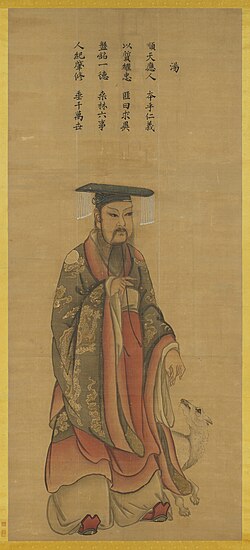
Tang of Shang
Named in the closing image of Qiao Zhou's essay - once destiny and the moment are right, 'the consummation will follow forthwith, as the armies of Kings Tang and Wu fought but one battle'.
1 mention in this chapter
6 mentions in the book
|
|
Tian Heng
Named in the poem for Zhuge Dan's guards, who refuse their lives one by one at the block: 'Faithful unto death were they, even as Tian Heng's people' - the five hundred who killed themselves rather than outlive their lord.
1 mention in this chapter
3 mentions in the book
|
|
Wang Ji
Wei's hardest-working general in the chapter. Commands the veteran rear with Chen Qian, springs the trap on the plunderers, is withdrawn from the south gate to leave Zhong Hui's opening, catches Zhu Yi's relief column from behind, and fights his way to the west gate at the fall of the city - where he meets Yu Quan and gets the answer that kills him.
7 mentions in this chapter
18 mentions in the book
|
|
Wang Zhen
Killed on the page. One of Sima Wang's two generals at Changcheng, he takes Fu Qian's challenge, thrusts at the opening Fu Qian deliberately offers, and is lifted bodily out of the saddle and carried off — then dashed to the ground and finished by the Shu troops where he lies.
5 mentions in this chapter
5 mentions in the book
|
|
Wen Hu
With his brother, kills scores of men in the rage that follows their father's execution and goes over the wall with him into the Wei camp. Pardoned on Zhong Hui's argument, given gifts, a lordship and a generalship, and rides round Shouchun with Wen Yang advertising it.
1 mention in this chapter
2 mentions in the book
|
|
Wen Qin
Killed by Zhuge Dan for the most reasonable suggestion anyone makes in the siege. Holding the citadel with his two sons and watching the garrison starve 'till the sight became unbearable', he proposes that 'The northern troops should be sent away in order to save food' - and gets 'Do you want to kill me that you propose to send the northern soldiers away?' and immediate execution. His death is the hinge of the chapter.
6 mentions in this chapter
25 mentions in the book
|
|
Wen Yang
His father's murder turns him into the instrument of the city's fall. He and Wen Hu 'ran amok with rage. Armed with short swords, they attacked all they met and slew many scores in their desperate anger', then dropped down the wall into the Wei camp. Sima Zhao, remembering the night ride at Lojia, means to kill him, and only Zhong Hui's argument saves him. Given gifts, a lordship and a generalship, he rides round the walls shouting that Sima Zhao has pardoned and rewarded the man who once defied his whole army - which is what makes the rest of the garrison want to surrender.
4 mentions in this chapter
14 mentions in the book
|
|
Xiang Yu
Named in Qiao Zhou's essay as the strong power destroyed only once the weak one had settled its own people - the Chu that Zhang Liang pursued and finished after the empire had been divided at the Grand Canal.
1 mention in this chapter
12 mentions in the book
|
|
Yu Quan
Dies in this chapter, and the chapter is named after it: 'Rescuing Shouchun, Yu Quan Dies Nobly'. He proposes the plan that gets a relief force through the deliberately-open south gate, goes in himself, and is still inside when the city falls. Wang Ji finds him at the west gate and calls on him to yield; the answer is the chapter's title: 'Where is the principle for yielding when I have my orders to rescue the city and so far have not succeeded?' He throws off his helmet — 'The happiest death a man can die is on the battlefield!' — and fights until he goes down under many wounds. The poem gives him the whole verse: 'Wu had produced its heroes, / Yet none were faithful to the death like Yu Quan.'
5 mentions in this chapter
6 mentions in the book
|
|
Zeng Xuan
Ends the siege. Commander of the north gate, he 'treacherously opened the gate and let in the Wei soldiers' at the moment Zhong Hui judges the garrison's will to be broken — which is what turns the assault into a capture.
1 mention in this chapter
1 mention in the book
|
|
Zhang Liang
Named twice, in two quite different registers. Sima Zhao calls Zhong Hui 'my Zhang Liang' after the three-sided siege plan; and Qiao Zhou's essay uses the historical Zhang Liang as the model of waiting for the moment - 'seeing that his people were satisfied and settled in their minds, Zhang Liang went in pursuit of Xiang Yu and destroyed him.'
2 mentions in this chapter
14 mentions in the book
|
|
Zhong Hui
Four separate decisions in this chapter are his, and Sima Zhao names him for it. Opens by reading the Wu alliance correctly — 'The Wu army is helping our enemies for the sake of profit, and hence we can seduce them with an offer of greater profit' — which produces the abandoned-baggage trap. Then designs the siege: attack on three sides only and leave the south gate open, so the garrison is tempted to run and the Wu relief is tempted in, while light cavalry cut their supply. 'You are my Zhang Liang,' said Sima Zhao, stroking the back of his adviser. Talks Sima Zhao out of executing Wen Yang — 'If you slay those who surrender, you will strengthen the obstinacy of those who remain in the city' — which is what collapses the garrison's will. And finally talks him out of Pei Xiu's proposal to bury the Wu prisoners: 'When the ancients made war, their policy was to maintain the state as a whole, and so they only put to death the originators of trouble. It would be inhumane to slay all.'
8 mentions in this chapter
131 mentions in the book
|
|
Zhou Cai
Paired with Shi Bao to lay the ambushes near Shouchun, and one of the two forces that break out of cover onto the enemy while they are busy gathering Chen Jun's abandoned baggage.
2 mentions in this chapter
3 mentions in the book
|
|
Zhu Yi
Sentenced to death by his own side. Leader of the Wu van, he is told by Sun Chen 'Now and here you have to win a victory or die, for another defeat will mean death', takes Yu Quan's plan, and is caught on the Shouchun road by Wang Ji and Chen Qian coming in behind him. 'When Sun Chen heard of this new defeat, he was very angry. "What is the use of leaders who always lose?" cried he.' Executed.
7 mentions in this chapter
10 mentions in the book
|
|
Zhuge Dan
Dies in this chapter, and does it to himself. Takes the abandoned-baggage bait and is driven back inside Shouchun on the first page. Refuses Jiang Ban and Jiao Yi's proposal to fight a decisive battle before the food runs out — 'If you say that again, you shall die as traitors!' — and loses them both over the wall that night. Pins his hopes on the autumn flood of River Huai breaking the besiegers' earth walls, and the autumn is dry. Kills Wen Qin for proposing to send the northern troops away to save food, which hands Sima Zhao the two best soldiers in the city. Then spends his last days patrolling his own ramparts night and day executing men who look like deserting — until Zeng Xuan opens the north gate. Run down on the drawbridge by Hu Fen and cut down; his whole family put to death.
18 mentions in this chapter
42 mentions in the book
|
-
Zhuge Dan's Rebellion Rebellion · c. June 257 – March or April 258 · ShouchunDefenders: Cao Wei
-
-
-
-
Anfeng Commandery Commandery
-
Changcheng
-
Chu State (Warring States/Spring+Autumn) Region
-
Grand Canal
-
Han State (Warring States) Region
-
Hanzhong Commandery Commandery(33.0730, 107.0359)
-
Jianye Settlement
-
Land Within the Passes Region
-
Luo Valley Landmark
-
Luoyang County(34.7316, 112.5963)
-
-
-
Middle Land Region
-
Qinchuan
-
River Huai River
-
River Wei River
-
Shen Ridge Mountains/Hills
-
Shouchun County
-
Shu (Three Kingdoms) Region
-
Wei (Three Kingdoms) Region
-
Wu (Three Kingdoms) Region
-
Xiangcheng