Ji Fa
姬發
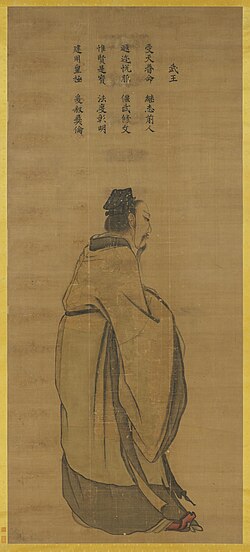
Source:
wikipedia.com
- Also known as
- King Wu of Zhou Wu
- Book mentions
- 24
Roles:
king
Factions:
Zhou Dynasty
(primary)
Links:
-
Wikipedia entry Bio
Appears in 7 chapters:
-
Chapter 44
— Zhuge Liang Stirs Zhou Yu To Actions; Sun Quan Decides To Attack Cao Cao.
King Wu of Zhou, invoked in the ode's climax - only 'the richly prosperous rule of Kings Wu and Huan' compares with the builder's sacred understanding.
-
Chapter 60
— Zhang Song Turns The Table On Yang Xiu; Pang Tong Proposes The Occupation Of Shu.
King Wu of Zhou — half of Pang Tong's precedent ('the teachings of the great Kings Tang and Wu') for annexing a weaker neighbour righteously.
-
Chapter 62
— The Taking Of River Fu Pass, Yang Huai and Gao Pei Perish; The Siege Of Luocheng, Huang Zhong and Wei Yan Rival.
Liu Bei's drunken defense at the victory feast — 'the success of King Wu of Zhou was celebrated with music' — the line that drives Pang Tong from the table.
-
Chapter 80
— Cao Pi Deposes The Emperor, Taking Away The Fortunes of Han; Liu Bei Assumes The Throne, Continuing The Heritage.
The Military King whose capability the abdication manifesto grants Cao Pi.
-
Chapter 98
— Pursuing The Shu Army, Wang Shuang Meets His Death; Raiding Chencang, Zhuge Liang Scores A Victory.
King Wu of Zhou, alluded to once in Zhang Zhao's memorial: 'your understanding is on a level with that of Kings Wen and Wu.'
-
Chapter 99
— Zhuge Liang Defeats The Wei Army; Sima Yi Invades The West River Land.
King Wu of Zhou, cited in Wang Su's memorial as the model for withdrawing from an over-extended campaign: 'King Wu of Zhou attacked the last king of Shang Dynasty; he went through the pass, but returned.'
-
Chapter 112
— Rescuing Shouchun, Yu Quan Dies Nobly; Attacking Changcheng, Jiang Wei Mobilizes.
King Wu of Zhou, named once in Qiao Zhou's essay, paired with Tang: 'as the armies of Kings Tang and Wu fought but one battle'.