Ji Chang
姬昌
Courtesy name: Xiahou (姬昌)
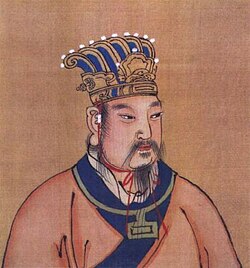
Source:
wikipedia.com
- Born
- 1152 BC
- Died
- 1050 BC
- Ancestral home
- Bi (Zhou state)
- Also known as
- King Wen of Zhou
- Book mentions
- 13
Roles:
king
Factions:
Zhou Dynasty
(primary)
Links:
-
Wikipedia entry Bio
Appears in 10 chapters:
-
Chapter 17
— Yuan Shu Marches Out Seven Armies; Cao Cao And Three Generals Join Forces.
King Wen, Ancestor of the Zhou - Yan Xiang's counter-example: he held two thirds of the empire and still served the Shang. Yuan Shu is no King Wen, and the Hans are no Shang.
-
Chapter 38
— Zhuge Liang Plans For The Three Kingdoms; Sun Quan Attacks Xiakou To Take Revenges.
King Wen, whose homage to old Lu Wang by the River Wei is Liu Bei's second precedent against his brothers' grumbling.
-
Chapter 44
— Zhuge Liang Stirs Zhou Yu To Actions; Sun Quan Decides To Attack Cao Cao.
King Wen, whose 'felicitous dream' of gathering scholars the ode credits to the tower's builder.
-
Chapter 56
— Cao Cao Feasts In The Bronze Bird Tower; Zhuge Liang Provokes Zhou Yu A Third Time.
King Wen of Zhou, 'perfectly virtuous' in the saying of Confucius that Cao Cao claims is engraved on his mind - the banquet speech's proof that he covets no throne.
-
Chapter 78
— Treating A Headache, A Famous Physician Dies; Giving The Last Words, The Crafty Hero Departs.
Cao Cao's chosen self-image at the brink: 'if the finger of heaven points to me, then shall I be as King Wen of Zhou' — the king who held power and left the throne-taking to his son.
-
Chapter 80
— Cao Pi Deposes The Emperor, Taking Away The Fortunes of Han; Liu Bei Assumes The Throne, Continuing The Heritage.
The Scholar King paired with Wu the Military King in the manifesto's flattery.
-
Chapter 98
— Pursuing The Shu Army, Wang Shuang Meets His Death; Raiding Chencang, Zhuge Liang Scores A Victory.
King Wen of Zhou, alluded to in Zhang Zhao's memorial as a standard of understanding: 'your understanding is on a level with that of Kings Wen and Wu.'
-
Chapter 112
— Rescuing Shouchun, Yu Quan Dies Nobly; Attacking Changcheng, Jiang Wei Mobilizes.
Named twice in Qiao Zhou's essay as the model of the patient ruler: 'King Wen of Zhou devoted himself to the welfare of his people, and with a small number achieved great results', and again in 'therefore one may play the part of King Wen'.
-
Chapter 114
— Driving To The South Gate, Cao Mao Plunges Into Death; Abandoning Stores, Jiang Wei Defeats The Wei Army.
Named in Sima Zhao's refusal of the throne: 'Formerly King Wen had two-thirds of the empire, and yet he supported and served the state of Yin to its end.'
-
Chapter 119
— The False Surrender: A Wit Scheme Becomes A Vain Plan; The Abdication: Later Seeds Learn From The Ancient.
Named in Sima Yan's opening question about his family's intentions: 'Cao Cao said that if the celestial mandate rested upon him, he could be no more than King Wen of Zhou, who served as a regent only. Is this really so?' The disclaimer every usurper in this book makes, examined by the one who finally drops it.