Confucius
孔子
Courtesy name: Zhongni (仲尼)
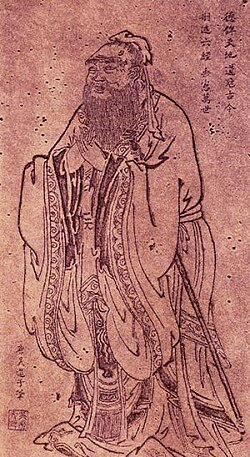
Source:
wikipedia.com
- Born
- 551 BCE
- Died
- 479 BCE
- Ancestral home
- Zou, Lu (now Qufu, Shandong)
- Also known as
- Kong Qiu Kong Fuzi
- Book mentions
- 16
Roles:
philosopher
Factions:
Lu State (Spring+Autumn)
(primary)
Relationships:
Kong Rong
Descendant
Links:
-
Wikipedia entry Bio
Appears in 13 chapters:
-
Chapter 11
— Liu Bei Rescues Kong Rong At Beihai; Lu Bu Defeats Cao Cao Near Puyang.
The great Teacher, ancestor of Kong Rong in the twentieth generation - and the hinge of the boy's famous retort: Confucius once questioned Laozi about ceremonies, so the families had 'known each other for generations'.
-
Chapter 23
— Mi Heng Slips His Garment And Rails At Traitors; Ji Ping Pledges To Kill The Prime Minister.
Mi Heng's measuring stick: he claims Confucius's virtue for himself, and casts Cao Cao as Yang Huo, the man who belittled the sage.
-
Chapter 29
— The Little Chief Of The South Slays Yu Ji; The Green Eyed Boy Lays Hold On The South Land.
Quoted twice by Lady Wu on the reality of spiritual beings - her scripture for making Sun Ce pray at the Jade Pure Monastery after Yu Ji's death.
-
Chapter 35
— Liu Bei Meets A Recluse At Nanzhang; Shan Fu Sees A Noble Lord At Xinye.
Quoted by Water Mirror to rebuke Liu Bei's despair of finding talent: 'In a hamlet of ten households there must be one true person.'
-
Chapter 40
— Lady Cai Renounces Jingzhou; Zhuge Liang Burns Xinye.
Invoked in the mutual flattery Chi Lu reports as sedition: 'Confucius is not dead, because Kong Rong is he.'
-
Chapter 56
— Cao Cao Feasts In The Bronze Bird Tower; Zhuge Liang Provokes Zhou Yu A Third Time.
Source of the King Wen saying Cao Cao builds his great apologia on - 'I ever bear in mind what Confucius said of King Wen of Zhou.'
-
Chapter 60
— Zhang Song Turns The Table On Yang Xiu; Pang Tong Proposes The Occupation Of Shu.
Invoked in Zhang Song's jibe at Yang Xiu: Cao Cao's learning 'throws no gleaming light on the way of Confucius or Mencius' — the sage as the measuring stick Cao Cao fails.
-
Chapter 62
— The Taking Of River Fu Pass, Yang Huai and Gao Pei Perish; The Siege Of Luocheng, Huang Zhong and Wei Yan Rival.
Quoted by Liu Gui to justify consulting the hermit: 'The Holy One has said that it is characteristic of the most entire sincerity to be able to foreknow.'
-
Chapter 78
— Treating A Headache, A Famous Physician Dies; Giving The Last Words, The Crafty Hero Departs.
Quoted at the end of everything — 'he who offends against heaven has no one to pray to' — the Wise Teacher's words with which Cao Cao refuses the priests.
-
Chapter 80
— Cao Pi Deposes The Emperor, Taking Away The Fortunes of Han; Liu Bei Assumes The Throne, Continuing The Heritage.
Quoted by Zhuge Liang to close the sickbed trap — 'if names be not correct, language is not in accordance with the truth of things.'
-
Chapter 105
— The Lord of Wuxiang Leaves A Plan In The Silken Bag; The Ruler of Wei Removes The Bronze Statue With The Dew Bowl.
Cited by Dong Xun in his memorial against the building works, as the authority on the reciprocal duties that Cao Rui is breaking: 'Confucius the Teacher said that princes should treat ministers with polite consideration, and ministers should serve princes with loyalty. Without loyalty, without propriety, can a state endure?'
-
Chapter 114
— Driving To The South Gate, Cao Mao Plunges Into Death; Abandoning Stores, Jiang Wei Defeats The Wei Army.
Named as the authority for Sima Zhao's self-justification: King Wen served Yin to the end, 'Wherefore Confucius called him "Complete of Virtue"'. The citation comes from a man who has just had his sovereign killed in the street.
-
Chapter 116
— On Hanzhong Roads, Zhong Hui Divides The Army; In Dingjun Mountain, The Martial Lord Shows His Apparition.
Cited inside Shao Yuan's reading of the Jian diagram, as the authority for what it means: 'Confucius said of Jian that it meant advantage in the southwest, that is, success, but the northeast spelt failure, that is, there was no road.'